Prologue
Soup Theory
There's a theory that all life on Earth originated from a primordial soup of organic molecules. Collisions of lightning and atmospheric gasses filled our empty oceans with the building blocks of life. Eons later, those simple molecules have evolved into millions of beautifully complex organisms. Currently, one of those organisms is burrowing through the soft paper bedding in its enclosure. The surface rustles here and there before, suddenly, a tiny, twitching pink nose emerges followed by a round, fuzzy body. It clambers out into the open and glances around with beady, black eyes.
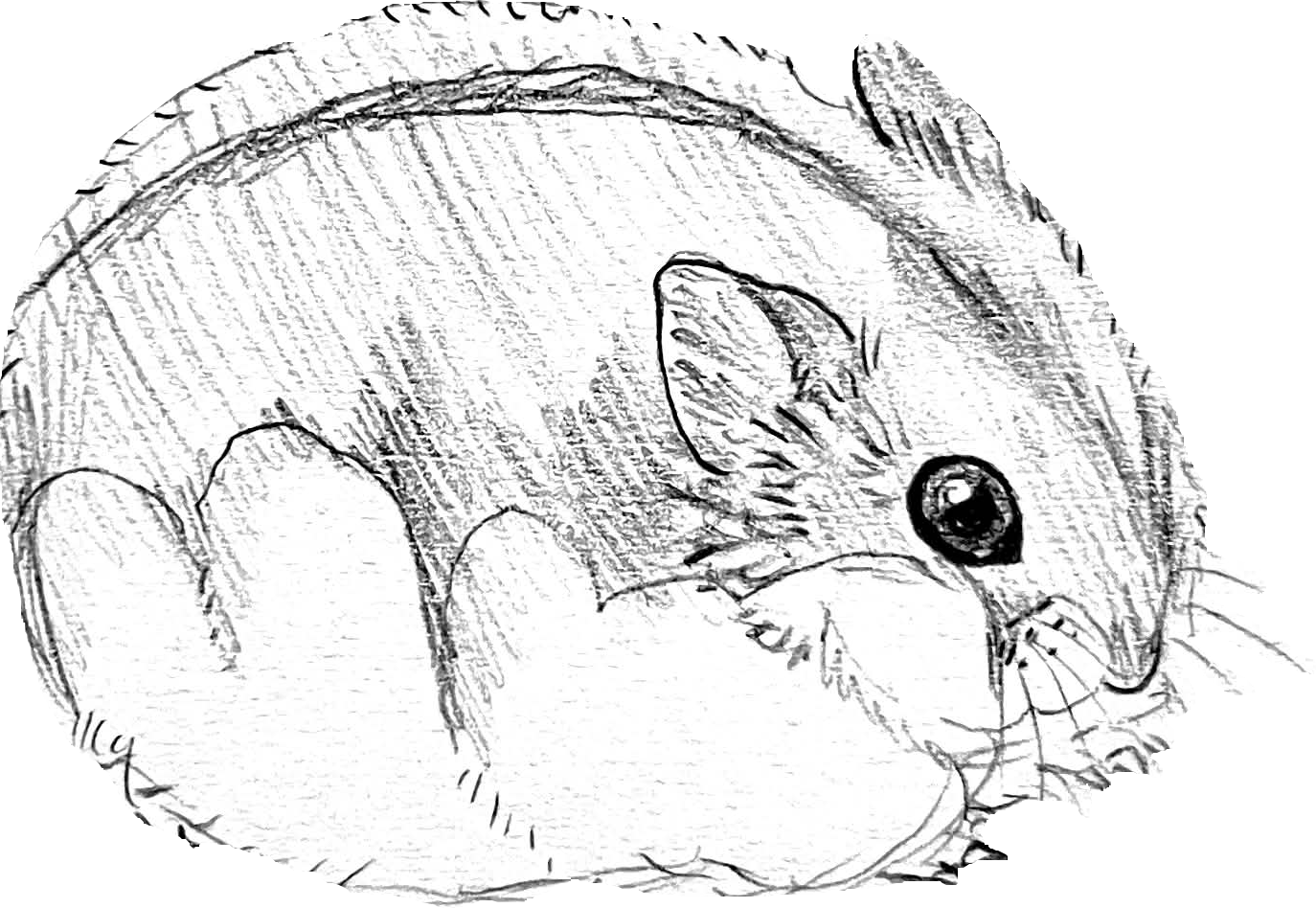
This is a Phodopus campbelli, more commonly known as a Campbell's dwarf hamster. It's a popular species in the pet trade, but its wild ancestors still inhabit the sweeping arid steppes and semi-deserts of Asia. To this single hamster, everything within its glass tank is its entire world. But what if it had more?
Somewhere in the cosmos, a planet roughly the same size and conditions as Earth has appeared. Unbeknownst to anyone on Earth, a handful of Campbell's dwarves are plucked up and whisked away to this foreign world. Here they'll be given free reign to colonize this planet as their own; a place where they can adapt and evolve their species to its fullest potential.
Instead of simple molecules, this new planet's primordial soup will be the Campbell's dwarf hamster! A Campbelli soup, if you will. This planet will need a name, though. How about we call it...Phodopolis?
Ingredients of an Ecosystem
A single species alone cannot make an ecosystem. An ecosystem is a community of organisms that each depend on each other in some way. There needs to be plants to convert the sun's rays into energy, animals to eat the plants and absorb their nutrients, and decomposers to break those nutrients back down into the environment after those animals die. This is why, instead of the hamsters, the first organisms to come to Phodopolis are thousands of bacterias and micro-organisms. Following that are lichens and mosses and algae.
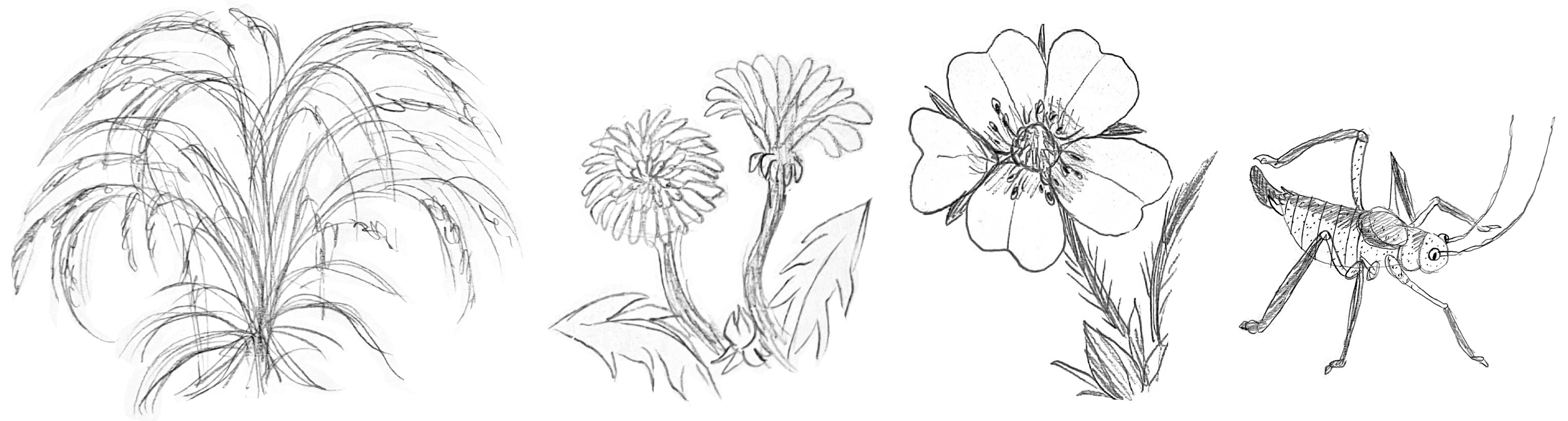
Wild dwarf hamsters on Earth have been observed eating a plethora of different plants. One field study found that silver feather grass (Stipa barbata) was their most preferred food. This is a tall, billowy grass that grows in large clumps. Its flowing tips turn into fuzzy, floral streamers when it blooms in summer.
Other plant species that'll find their way to Phodopolis are the common dandelion (Taraxacum officinale) and the sulfur cinquefoil (Potentilla recta). These golden flowers are incredibly hardy. They can self-pollinate, meaning they don't need the help of insects or their environment in order to produce their massive amounts of seeds.
This doesn't mean that insects won't come to Phodopolis. Hamsters are omnivores and insects make up an important part of their natural diet! So, the speckled bush-cricket (Leptophyes punctatissima) will also be introduced to Phodopolis. This flightless insect will become both prey and a competitor for the hamsters. It will push the foliage of Phodopolis to evolve in amazing ways in order to avoid being wiped out by its destructive appetite.
Once these species have established themselves comfortably, it's time to introduce the hamsters.
This is Origin
Phodopolis is a planet with roughly the same size and conditions as Earth, although its temperatures are slightly cooler. Amidst its empty oceans are hundreds of scattered islands. One of these islands, a mountainous landmass called Origin, will be the starting point for all life on Phodopolis. Every organism transplanted into this world will been placed here. One day, life will find its way to the barren islands in the distance but, for now, it stays on Origin.
Much like the dwarf hamster's natural habitat on Earth, our colonists will find themselves in a semi-arid steppe. The rocky slopes are dappled in clusters of feather grasses interspersed with patches of dandelions and gloriously tall cinquefoils. Speckled bush-crickets hop through the foliage, occasionally stopping to nibble on a leaf or golden petal. Occasionally, cold gusts of wind buffet the steppes, sending ripples cascading through the grasses like shimmering, silver waves.
Immediately, the hamsters set out to do what millions of years of evolution on Earth have wired them to do. They carve out deep, multi-chambered burrows where they spend the day fast asleep. When night creeps up, they dart across miles of territory, filling their cheek pouches with forage, nesting materials, and the occasional cricket. They fight off competitors, search for mates, and eventually reproduce.
As time moves on, their species begin to adjust to what it means to be at the top of the food chain, the sole mammal of an entire planet. They'll begin to bend and change what it even means to be a hamster.