Satellite bush-cricket
| Satellite bush-cricket | |
|---|---|
| |
| Scientific classification | |
| Kingdom: | Animalia |
| Phylum: | Anthropoda |
| Class: | Insecta |
| Order: | Orthoptera |
| Suborder: | Ensifera |
| Family: | Tettigoniidae |
| Subfamily: | Phaneropterinae |
| Genus: | Leptophyes |
| Species: | L. silfaelis |
| Evolution | |
| Ancestor: | Starry bush-cricket |
| Descendants: |
Click to reveal
|
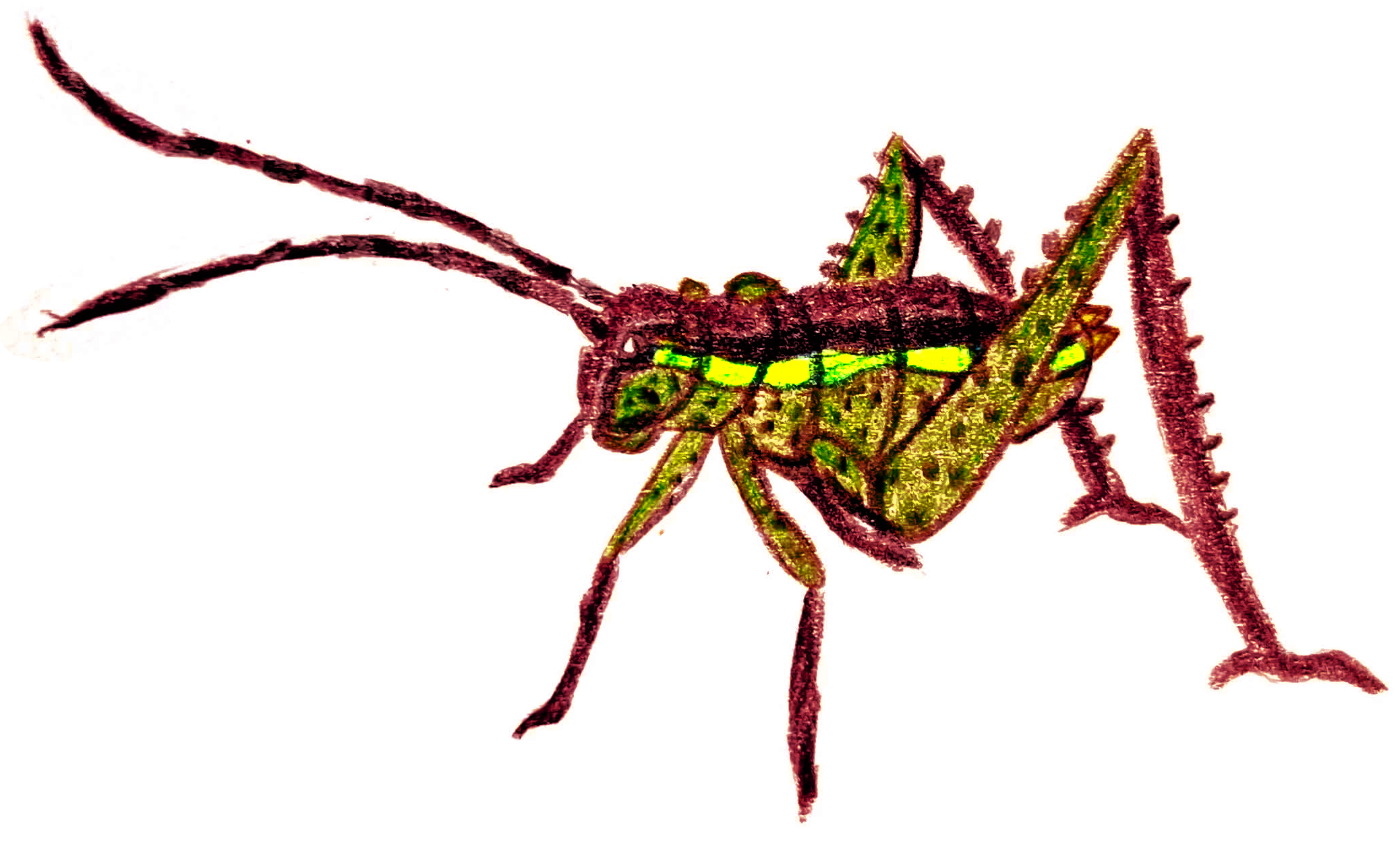
The satellite bush-cricket (Leptophyes silfaelis) is a descendant of the satellite bush-cricket. The two regularly interbreed and create hybrid offspring, although these hybrids are less likely to be healthy. It species name means "silent thief."
Description
At about 3-4 centimeters in length, the satellite bush-cricket looks like a smaller, wingless version of the starry bush-cricket. Often, it will be darker in color too, usually a shade of green or yellow. It has visible spines along its hind legs; an adapted defense against predators. Nymphs appear as smaller, wingless versions of the adult.
Diet
It feeds exclusively on plant matter, especially leaves.
Behaviour
It is active during dusk and nighttime. Massive colonies can be found inside giant, tangled cinquefoil bushes. When a predator is near, nymphs will become motionless while adults will quickly run or leap away.
Life Cycle & Reproduction
A nymph will molt six times before becoming sexually mature. When its mature, it looks for a mate. Since it has no wings, it cannot sing to attract a mate. Instead, it will follow the songs of starry bush-crickets. Male satellite bush-crickets will orbit around male starry bush-crickets, attempting to steal any prospective mates who are attracted by his singing.
During copulation, the male delivers a sack of sperm called a spermatophore to the female. The female will then eat this spermatophore. To increase the likelihood of his sperm fertilizing her before she eats it all, the sack is surrounded in a nutritious, sperm-free substance often referred to as a nuptial gift. Unlike nuptial gifts from the speckled bush-crickets which have no nutritional value, the satellite bush-cricket's nuptial gift contains protein which helps ensure the offspring are healthy and strong.
After mating, the female will lay a batch of eggs inside of a soft or dying plant stem or beneath fallen leaves. She may lay up to 150 eggs before she dies. The eggs stay dormant through the winter before hatching in spring.
Evolution
Because their wings are so small, it was inevitable that some starry bush-crickets would be born without wings. These bush-crickets were able to adapt by developing satellite behaviour — a mating tactic that is found in multiple animal species on Earth, such as the tree cricket.